
Introduction:
In recent years, the integration of Artificial Intelligence (AI) in finance has ushered in a new era of innovation and efficiency. AI’s transformative impact is felt across various sectors, with its application in banking and financial analysis being particularly noteworthy.
AI’s presence in the finance industry is undeniable. Through the synergy of machine learning and AI, financial institutions can harness the power of data to make more accurate predictions, streamline processes, and enhance customer experiences. AI is being used extensively in tasks like fraud detection, risk assessment, and customer service, revolutionizing how financial operations are conducted.
Role of AI in banking and finance:
AI algorithms, powered by machine learning, analyze vast amounts of historical and real-time data to predict market trends, assess risks, and optimize investment strategies. Furthermore, AI-driven chatbots streamline customer interactions, offering personalized assistance round the clock. From fraud detection to algorithmic trading, AI’s multifaceted applications are reshaping the core functions of banking and finance, ushering in a new era of innovation.
Future of AI in finance:

The future of AI in finance holds immense promise as technology continues to evolve. With each passing day, AI is becoming more sophisticated and capable of transforming financial operations. We can anticipate a future where AI-powered algorithms will offer personalized financial advice, leveraging individual spending patterns and economic trends. Additionally, AI’s role in risk assessment and fraud detection will become even more refined, ensuring heightened security and trust in financial transactions. The potential for AI to navigate complex financial markets and make real-time investment decisions holds great potential for optimizing portfolio management.
AI tools for finance:
Here are some AI tools which helps in finance:
1. Domo:

Domo’s AI capabilities enable it to ingest data from various sources, ranging from spreadsheets to cloud applications, creating a centralized and real-time data repository. Through advanced machine learning algorithms, Domo extracts actionable insights from this data, identifying trends, patterns, and anomalies that might have gone unnoticed. Its intuitive interface allows users to create interactive dashboards and reports, fostering data-driven collaboration and informed decision-making. Domo’s AI engine continuously refines its understanding of user preferences, adapting over time to provide increasingly relevant and personalized insights.
2. Datarails:
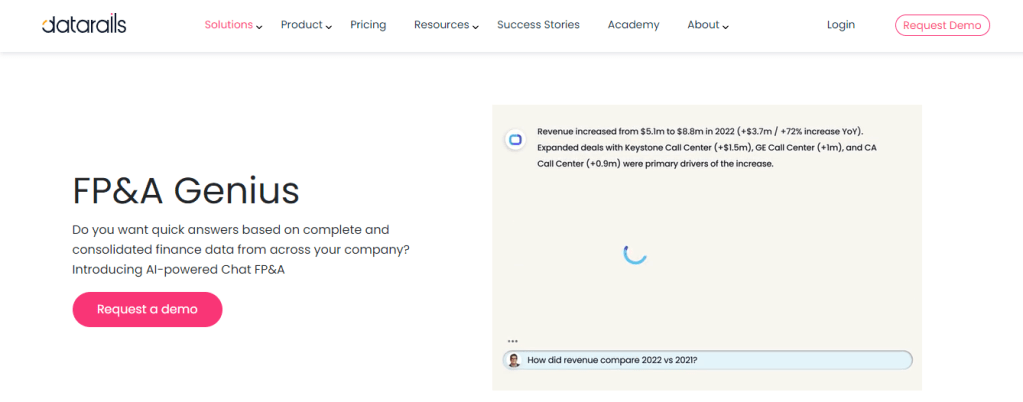
The platform seamlessly integrates with various data sources and ERP systems, creating a centralized hub for financial data. Through AI-driven algorithms, Datarails automates data aggregation, validation, and analysis, reducing manual errors and saving valuable time. It empowers finance teams to make data-backed decisions by providing real-time insights and customizable visualizations. As an AI-powered solution, Datarails continually learns from historical data and user interactions, adapting to evolving business needs and enhancing its accuracy over time.
3. Booke.AI:

Booke.AI stands at the forefront of AI-powered innovation, offering a game-changing solution in the realm of accounting and bookkeeping. This transformative platform leverages advanced AI algorithms to automate and streamline financial processes, reshaping traditional bookkeeping practices. Booke.AI seamlessly integrates with various accounting systems and data sources, creating a centralized repository for financial data. This innovative tool not only boosts efficiency but also reduces human errors, allowing businesses to allocate resources more strategically and focus on growth-oriented endeavors. Booke.AI’s machine learning capabilities enable it to adapt and learn from historical data, enhancing its accuracy and insights over time.
4. Rebank:

Rebank emerges as a groundbreaking solution in the financial technology landscape, redefining how businesses manage their banking needs. With its innovative approach, Rebank offers a seamless and efficient banking experience tailored to modern enterprises. This platform integrates advanced AI algorithms to optimize cash flow management, facilitate real-time financial monitoring, and streamline payment processes. Rebank’s user-friendly interface empowers businesses to make informed decisions by providing actionable insights into their financial health. This transformative tool not only improves financial efficiency but also enables companies to unlock new growth opportunities.
5. Nanonets:
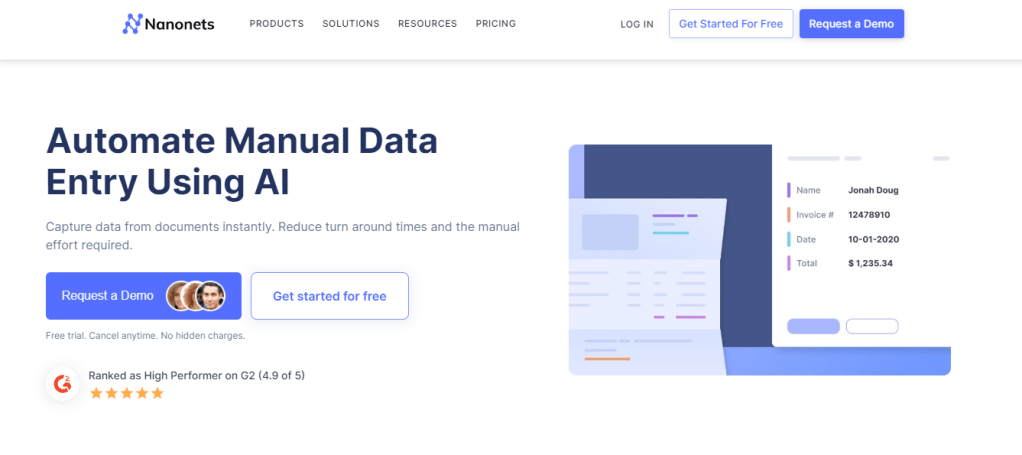
With Nanonets, businesses can seamlessly transform unstructured data from documents into valuable insights, saving time and minimizing errors. The platform’s intuitive interface enables effortless integration, empowering users to train AI models without extensive coding knowledge. Nanonets’ AI-driven accuracy improves over time, ensuring consistent and reliable results. By automating complex data extraction tasks, Nanonets not only enhances operational efficiency but also empowers organizations to make more informed decisions. As a powerful AI tool, Nanonets represents a paradigm shift in document processing, offering businesses a competitive edge in data-driven decision-making.
6. Trullion:

Trullion emerges as a cutting-edge solution in the realm of financial data management, offering a revolutionary approach to automating complex lease accounting and compliance tasks. Through advanced AI and machine learning capabilities, Trullion streamlines the process of extracting, organizing, and analyzing lease data, ensuring accuracy and adherence to regulatory standards. This innovative platform not only enhances operational efficiency but also minimizes the risk of errors in lease accounting, a critical aspect of financial management. With Trullion, businesses can confidently navigate the intricacies of lease compliance, freeing up resources for strategic decision-making and growth-oriented endeavors.
Applications of AI in finance:
One prominent application is risk assessment and management. AI-powered algorithms analyze vast datasets to predict potential risks, enabling financial institutions to make informed decisions and allocate resources effectively. This results in improved portfolio management and reduced exposure to financial uncertainties.
Another crucial application is fraud detection and prevention. AI algorithms can quickly identify unusual patterns and anomalies in transactions, enabling early detection of fraudulent activities. This proactive approach safeguards both customers and financial institutions, preserving trust and minimizing financial losses.
AI’s role in customer service cannot be overlooked. Chatbots powered by AI provide personalized assistance 24/7, answering queries and guiding customers through various processes. This not only enhances customer experiences but also reduces the workload of human agents, allowing them to focus on more complex tasks.
The application of AI in financial analysis is transformative. Advanced algorithms process extensive historical and real-time financial data to identify trends and insights that guide investment strategies. This assists financial professionals in making data-driven decisions that optimize portfolio performance.
In essence, AI’s applications in finance span risk management, fraud detection, trading, customer service, credit scoring, financial analysis, and even the transformation of transactional processes. As AI continues to evolve, its applications in finance will only grow, reshaping the industry and enhancing its efficiency, accuracy, and accessibility.
Example of AI in finance:
An exemplary illustration of AI’s impact in the realm of finance is its application in financial analysis. AI-driven algorithms swiftly process and analyze extensive historical financial data, revealing intricate trends and patterns that might elude human analysts. This enables financial institutions to make data-backed decisions, minimizing risks and capitalizing on opportunities. Furthermore, AI’s predictive capabilities empower investors to make informed choices, optimizing investment strategies and enhancing portfolio management.
As AI continues to evolve, its role in financial analysis promises to deliver more accurate insights, better risk assessments, and a deeper understanding of market dynamics, fostering a more robust and adaptive financial landscape.
Conclusion:
In conclusion, AI’s transformative influence on the finance sector is undeniable. The integration of artificial intelligence has redefined traditional financial processes, enhancing efficiency, accuracy, and customer experiences. From risk assessment and fraud detection to algorithmic trading and personalized customer service, AI’s applications are diverse and far-reaching. Its ability to process vast datasets in real-time, offer data-driven insights, and automate routine tasks is revolutionizing how financial institutions operate. As AI continues to evolve, its role in finance will expand, driving innovation, optimizing decision-making, and reshaping the industry’s landscape.

 AI Hub
Leave a comment